A system consisting of n components or subsystems, of which only k need to be functioning for system success, is called a “k-out-of-n” configuration. For such a system, k is less than n. An example of such a system might be an air traffic control system with n displays of which k must operate to meet the system reliability requirement.
For the sake of simplicity, let us assume that the units are identical, they are all operating simultaneously, and failures are statistically independent. Then,
R = reliability of one unit for a specified time period
Q = unreliability of one unit for a specified time period
and R + Q = 1
For n units
(R + Q)n = 1

This is nothing more than the familiar binomial expansion of (R + Q)n Thus,



Let us look at the specific case of four display equipment which meet the previously mentioned assumptions.
(R + Q)4 = R4 + 4R3Q + 6R2Q2 + 4RQ3 + Q4 = 1
from which
R4 = P(all four will survive)
4R3Q = P(exactly 3 will survive)
6R2Q2 = P(exactly 2 will survive)
4RQ3 = P(exactly 1 will survive)
Q4 = P(all will fail)
We are usually interested in k out of n surviving
R4 + 4R3Q = 1 – 6R2Q2 – 4RQ3 – Q4 = P(at least 3 survive)
R4 + 4R3Q + 6R2Q2 = 1 – 4RQ3 – Q4 = P(at least 2 survive)
R4 + 4R3Q + 6R2Q2 + 4RQ3 = 1 – Q4 = P(at least 1 survives)
If the reliability of each display for some time t is 0.9, what is the system reliability for time t if 3 out of 4 displays must be working?
RS = R4 + 4R3Q = (0.9)4 + 4(0.9)3(0.1) = 0.6561 + 0.2916 = 0.9477
Reliability Analytics Toolkit Example, System State Enumeration Tool
Here we apply the System State Enumeration tool from the Reliability Analytics Toolkit to the above problem, with our inputs highlighted in yellow. This tool enumerates all the possible successful states the system can be in and then sums the probabilities for each state, arriving at the same answer shown above. D1, D2, etc. is used as a shorthand for the four displays, with each unique name followed by a single space and then an associated reliability value. Here we check off “show calculation details,” which shows the computations involved for each state probability calculation within the generated results table.
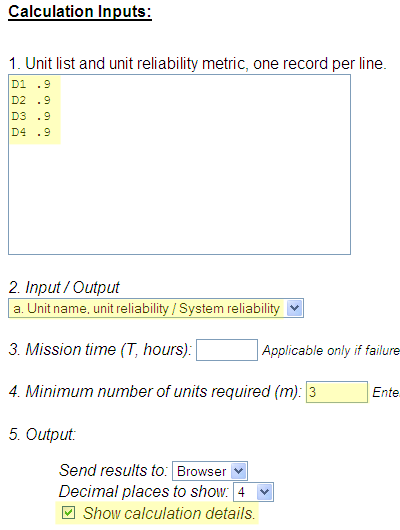
Solution:
For 3 of 4 units required, there are a total of 5 successful operating states.

The overall probability of successful system operation for 4 units, where a minimum of 3 are required, is the sum of the individual state probabilities listed in the right-hand column above:
Roverall = 0.9 * 0.9 * 0.9 * 0.9 + 0.9 * 0.9 * 0.9 * (1 – 0.9) + 0.9 * 0.9 * 0.9 * (1 – 0.9) + 0.9 * 0.9 * 0.9 * (1 – 0.9) + 0.9 * 0.9 * 0.9 * (1 – 0.9)
Roverall = 0.9477
References:
1. MIL-HDBK-338, Electronic Reliability Design Handbook, 15 Oct 84
2. Bazovsky, Igor, Reliability Theory and Practice
3. O’Connor, Patrick, D. T., Practical Reliability Engineering
4. Birolini, Alessandro, Reliability Engineering: Theory and Practice