Discrete event simulation (DES) is a powerful technique that can be used to to solve more complex system reliability modeling and supportability problems. This article discusses using the Discrete Event Simulation tool in the Reliability Analytics Toolkit for spare parts planning purposes.
Category Archives: Reliability Modeling
State Enumeration Tool MIL-STD-756 Example
The Reliability Analytics Toolkit System States tool provides the equivalent functionality as the Method 1002 procedure described in MIL-STD-756, Reliability Modeling and Prediction. While the approach described in MIL-STD-756 is very tedious, the System States tool makes the analysis process far easier. Continue reading
Discrete Event Simulation, Example 3, Comparison to Redundancy Equation Approach
This article compares the results obtained using the Discrete Event Simulation (DES) tool to those obtained deterministically by integrating the reliability function using this tool. Continue reading
Estimating MTBF Based on L10 Life
The Reliability Analytics Toolkit L10 to MTBF Conversion tool provides a quick and easy way to convert a quoted L10% life to an average failure rate (or MTBF), provided that an educated guess can be made regarding a Weibull shape parameter (β). Continue reading
Reliability Modeling: k out of n Configutations
A system consisting of n components or subsystems, of which only k need to be functioning for system success, is called a “k-out-of-n” configuration. For such a system, k is less than n. An example of such a system might be an air traffic control system with n displays of which k must operate to meet the system reliability requirement.
Reliability Modeling: Combination of Series and Parallel
Most practical equipments and systems are combinations of series and parallel components as shown below
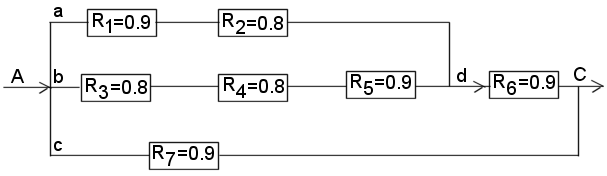
To solve this network, one merely uses series and parallel relationships to decompose and recombine the network step by step. Continue reading
Reliability Modeling: Parallel Configuration
A commonly occurring configuration encountered in reliability mathematical modeling is the parallel configuration as shown in the reliability block diagram below

For this case, for the system to fail, all of the components would have to fail. Continue reading
Reliability Modeling: Series Configuration
The reliability functions of some simple, well known structures will be derived. These functions are based upon the exponential distribution of time to failure.
Series Configurations
The simplest and perhaps most commonly occurring configuration in reliability mathematical modeling is the series configuration. The successful operation of the system depends on the proper functioning of all the system components. A component failure represents total system failure. A series reliability configuration is represented by the block diagram as shown below with n components.
