This is probably the most important distribution in reliability work and is used almost exclusively for reliability prediction of electronic equipment. It describes the situation wherein the hazard rate is constant which can be shown to be generated by a Poisson process. This distribution is valuable if properly used. It has the advantages of:
- single, easily estimated parameter (λ)
- mathematically very tractable
- fairly wide applicability
- is additive that is, the sum of a number of independent exponentially distributed variables is exponentially distributed.
Some particular applications of this model include:
- items whose failure rate does not change significantly with age.
- complex and repairable equipment without excessive amounts of redundancy.
- equipment for which the early failures or “infant mortalities” have been eliminated by “burning in” the equipment for some reasonable time period.
The failure density function is

for t > 0, where λ is the hazard (failure) rate, and the reliability function is

the mean life (θ) = 1/λ, and, for repairable equipment the MTBF = θ = 1/λ .
Basic Example 1
The mean time to failure (MTTF = θ, for this case) of an airborne fire control system is 10 hours. What is the probability that it will not fail during a 3 hour mission?

Reliability Analytics Toolkit, first approach (Basic Example 1)
While this is an extremely simple problem, we will demonstrate the same solution using the System State Enumeration tool of the Reliability Analytics Toolkit, inputs 1-3. For this single item, there are only two possible states, operating and failed. The mean life is 10 hours, so the hazard rate is 0.10. The toolkit takes input in units of failures per million hours (FPMH), so 0.10 failures/hour is equivalent to 10,000 FPMH, which is entered in box 1. We are interest in computing R(t), so we select option b for input 2. The 3 hour mission time is entered for item 3 and one operating unit is required for success, so 1 is entered for item 4. Note, the tool is intended more for computing possible states and reliability for more complex redundant configurations.
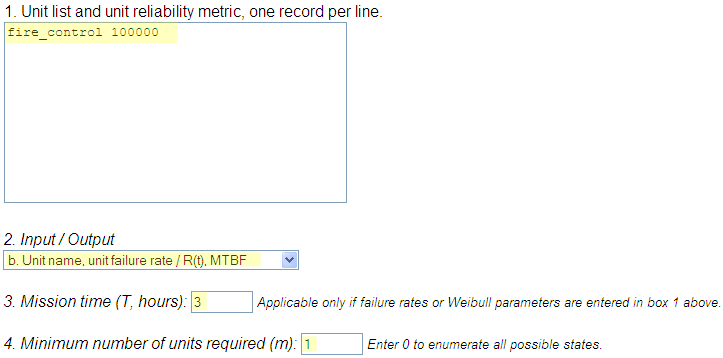
results in the following solution
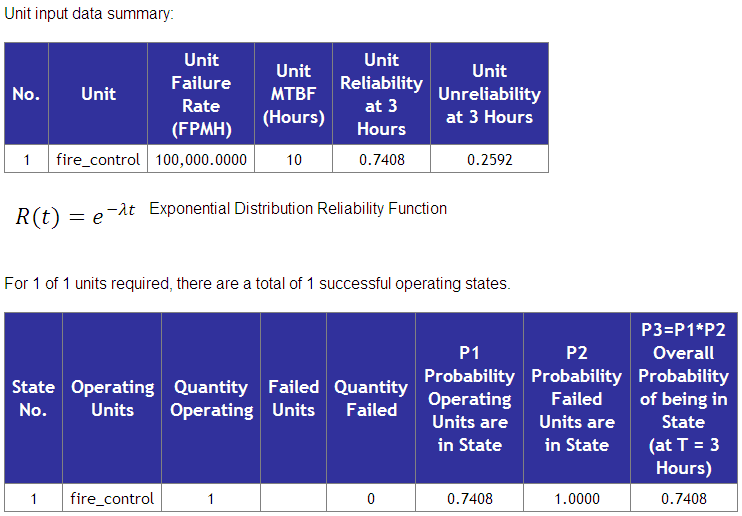
The overall probability of successful system operation for 1 units, where a minimum of 1 is required, is the sum of the individual state probabilities listed in the right-hand column above:
R(3) = 0.7408
Reliability Analytics Toolkit, second approach (Basic Example 1)
While this is an extremely simple problem, we will demonstrate the same solution using the the “Active redundancy, with repair, Weibull” tool of the Reliability Analytics Toolkit. While this tool is intended for more complicated calculations to determine effective system MTBF for more complex redundant configurations, we will apply it here by entering the inputs highlighted in yellow below:
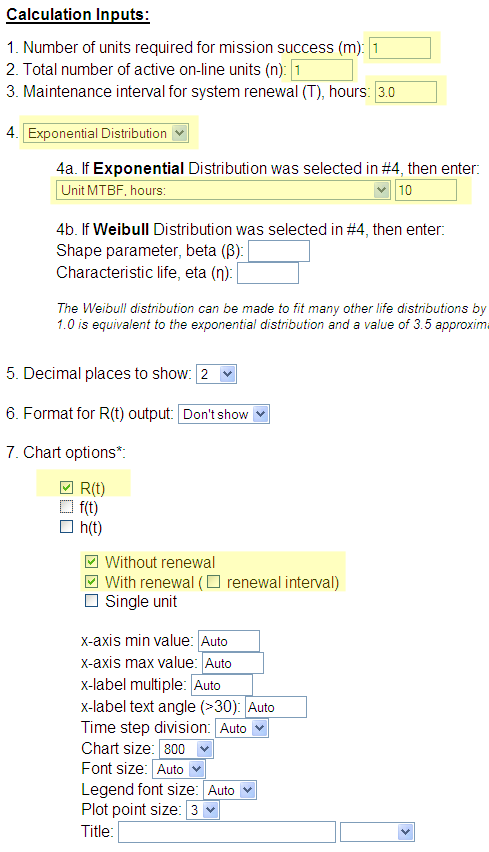
which results in the following solution
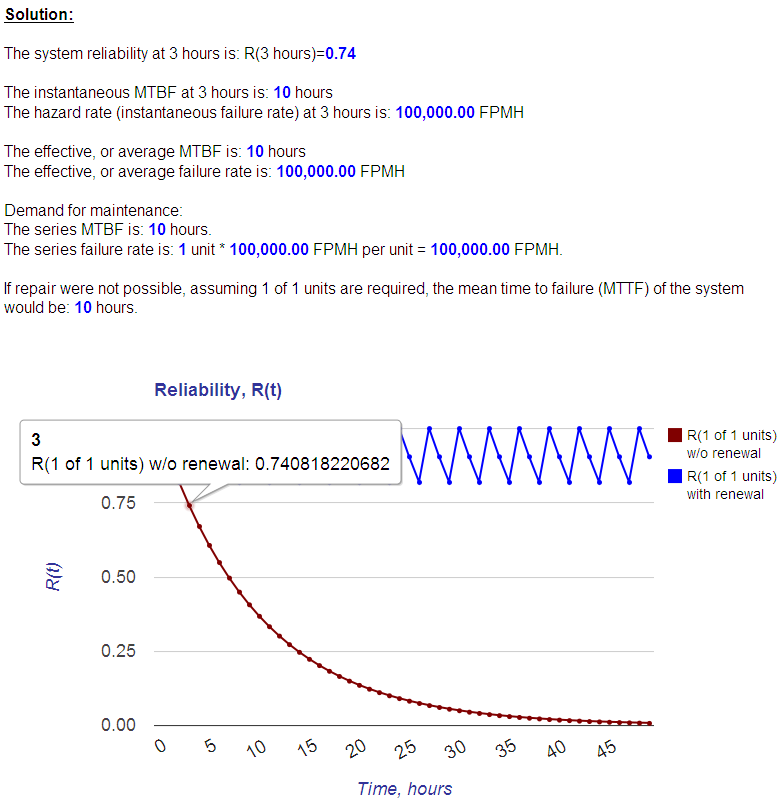
Basic Example 2
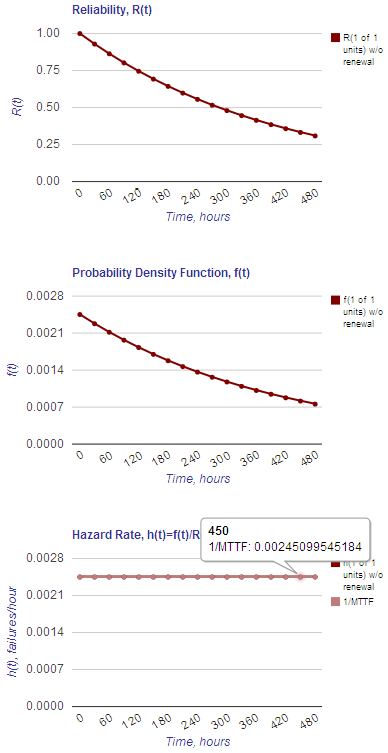
A computer has a constant error rate of one error every 17 days of continuous operation. What is the reliability associated with the computer to correctly solve a problem that requires 5 hours time? Find the hazard rate after 5 hours of operation.
MTTF = θ = 408 hours
λ = 1/ θ = 0.0024 failure/hour


Reliability Analytics Toolkit (Basic Example 2)
While this is an extremely simple problem, we will demonstrate the same solution and plotting capability using the the “Active redundancy, with repair, Weibull” tool of the Reliability Analytics Toolkit. While this tool is intended for more complicated calculations to determine effective system MTBF for more complex redundant configurations, we will apply it here by entering the inputs highlighted in yellow below:
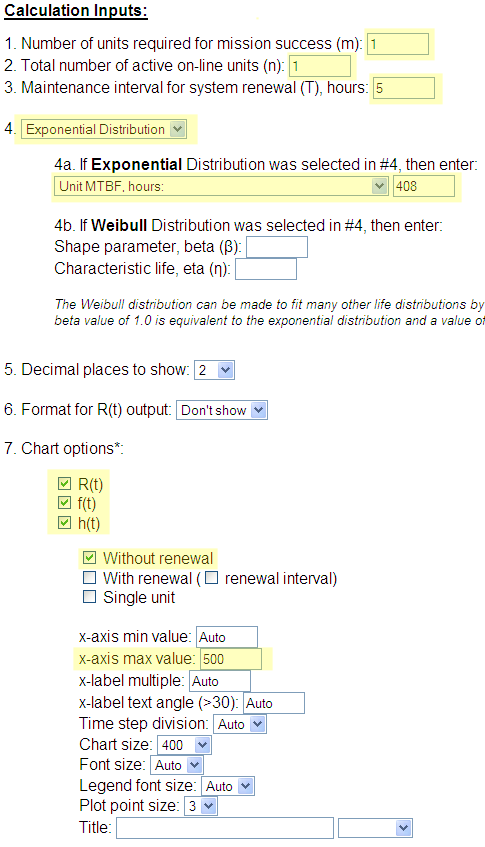
which results in the following solution
References:
1. MIL-HDBK-338, Electronic Reliability Design Handbook, 15 Oct 84
2. Bazovsky, Igor, Reliability Theory and Practice
3. O’Connor, Patrick, D. T., Practical Reliability Engineering
4. Birolini, Alessandro, Reliability Engineering: Theory and Practice