A commonly occurring configuration encountered in reliability mathematical modeling is the parallel configuration as shown in the reliability block diagram below

For this case, for the system to fail, all of the components would have to fail. Letting

the probability of failure (or unreliability) of each component, the unreliability of the system would be given by
QS = Q1 ·Q2 … Qn
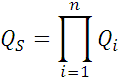
and the reliability of the system would be
RS = 1 – QS
since R + Q = 1.
Consider such a system composed of five parallel components, each with a reliability of 0.99. Then


Thus, parallel configurations, or the use of redundancy, is one of the design procedures used to achieve extremely high system reliability, greater than the individual component reliabilities. Of course, this is a very simple concept, which becomes more complicated in actual practice.
Reliability Analytics Toolkit Example, System State Enumeration Tool
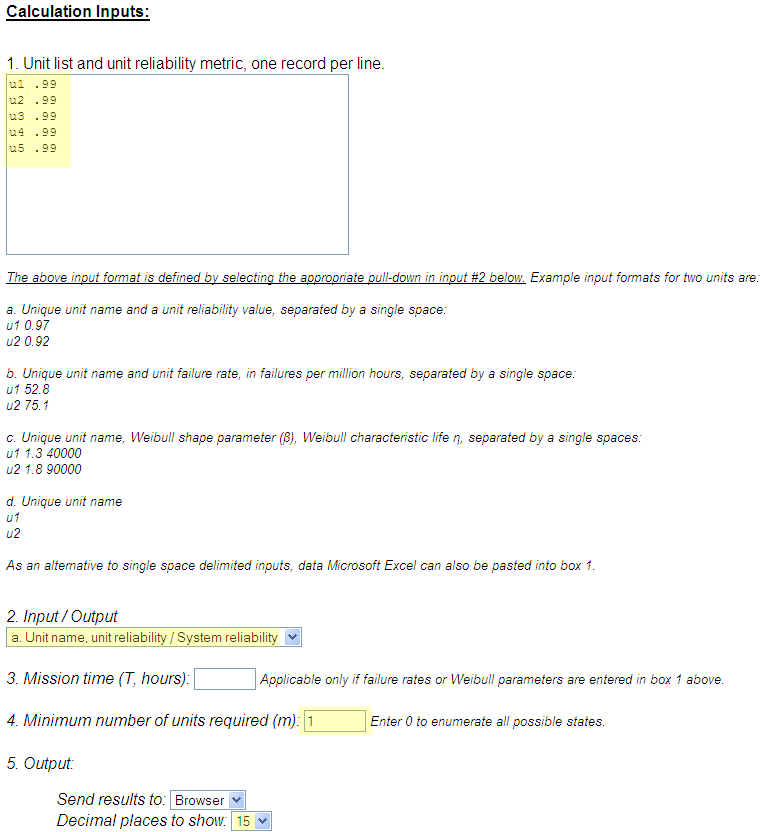
Here we apply the System State Enumeration tool from the Reliability Analytics Toolkit to the problem above, with our inputs highlighted in yellow. This tool enumerates all the possible successful states the system can be in and then sums the probabilities for each state, arriving at the same answer shown above. u1, u2, etc. is used as a shorthand for “unit”, with the five items listed in box 1. The input format is a unique unit name, followed by a single space, followed by the unit reliability (0.99). Since we are entering a unit name and associated reliability in box 1, we select this option in the item 2 pull-down. We are assuming that only one of the five items are required, which is entered as input 4. Finally, we elect to display results to 15 decimal places.
Solution:
For 1 of 5 units required, there are a total of 31 successful operating states
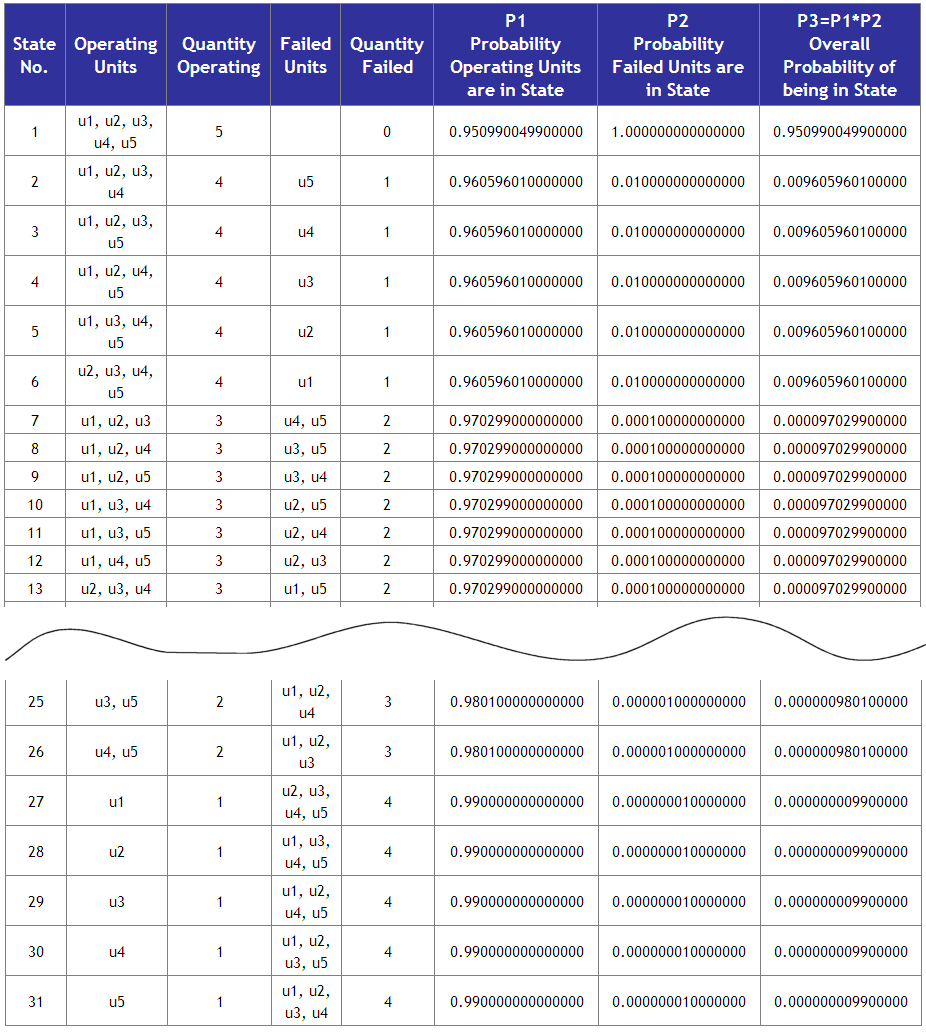
The overall probability of successful system operation for 5 units, where a minimum of 1 is required, is the sum of the individual state probabilities listed in the right-hand column above:
Roverall = 0.999999999900001
Although not demonstrated here, the the System State Enumeration tool also includes the capability to exclude (define as being unsuccessful) specific states, allowing for system models with a very fine “granularity.”
References:
1. MIL-HDBK-338, Electronic Reliability Design Handbook, 15 Oct 84
2. Bazovsky, Igor, Reliability Theory and Practice
3. O’Connor, Patrick, D. T., Practical Reliability Engineering
4. Birolini, Alessandro, Reliability Engineering: Theory and Practice