The reliability functions of some simple, well known structures will be derived. These functions are based upon the exponential distribution of time to failure.
Series Configurations
The simplest and perhaps most commonly occurring configuration in reliability mathematical modeling is the series configuration. The successful operation of the system depends on the proper functioning of all the system components. A component failure represents total system failure. A series reliability configuration is represented by the block diagram as shown below with n components.

Further, assume that the failure of any one component is statistically independent of the failure or success of any other. This is usually the case for most practical purposes. If this is not the case, then conditional probabilities must be used, which only increase the complexity of the calculations.
Thus, for the configuration of shown above, under the assumptions made, the series reliability is given by
RS(t) = R1(t)·R2(t)·R3(t) … Rn(t)
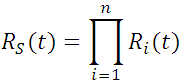
If a constant failure rate can be assumed for each component, which means the exponential distribution for the reliability function, then


where
λ = λ1·λ2·λ3 … λn = 1/Θ
Thus, the system failure rate, λ, is the sum of the individual component failure rates and the system mean life, Θ = 1/λ.
Consider a system composed of 400 component parts each having an exponential time to failure density function. Let us further assume that each component part has a reliability of 0.99 for some time t. The system reliability for the same time t is

Out of a 1,000 component system, 982 would fail to survive to time t.
Note for the case of component replacement upon failure, MTBF = Θ = 1/λ
and
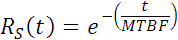
and, for the exponential distribution, the probability of surviving one MTBF without failure is

or only 37% !
References:
1. MIL-HDBK-338, Electronic Reliability Design Handbook, 15 Oct 84
2. Bazovsky, Igor, Reliability Theory and Practice
3. O’Connor, Patrick, D. T., Practical Reliability Engineering
4. Birolini, Alessandro, Reliability Engineering: Theory and Practice