Most practical equipments and systems are combinations of series and parallel components as shown below
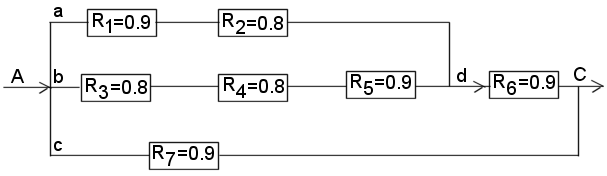
To solve this network, one merely uses series and parallel relationships to decompose and recombine the network step by step. For example
Rad = R1 · R2 = (0.9)(0.8) = 0.72
Rbd = R3 · R4 · R5 = (0.8)(0.8)(0.9) = 0.576
but Rad and Rbd are in parallel; thus, the unreliability of this parallel subsystem (S1) is
QS1 = Qad · Qbd = (1 – Rad)(1 – Rbd) = (1 – 0.72)(1 – 0.576) = (0.28)(0.424) = 0.119
and its reliability is
RS1 = 1 – QS1 = 1 – 0.119 = 0.881
Now the network has been decomposed to
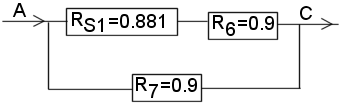
Letting RS2 equal the combined reliability of RS1 and R6 in series
RS2 = RS1 · R6 = (0.881)(0.9) = 0.793
QS2 = 1 – RS2 = 1 – 0.793 = 0.207
Q7 = 1 – R7 = 1 – 0.7 = 0.3
Since QS2 and Q7 are in parallel, the total system unreliability is
QAC = QS2 · Q7 = (0.207)(0.3) = 0.0621 and the total network reliability is
RAC = 1 – QAC = 1 – 0.0621 = 0.938
thus, the reliability of the combined network is 0.94, rounded to two decimal places.
The System State Enumeration tool from the Reliability Analytics Toolkit can be easily be applied to solve this and similar problems, using similar series-parallel decomposition methods.
References:
1. MIL-HDBK-338, Electronic Reliability Design Handbook, 15 Oct 84
2. Bazovsky, Igor, Reliability Theory and Practice
3. O’Connor, Patrick, D. T., Practical Reliability Engineering
4. Birolini, Alessandro, Reliability Engineering: Theory and Practice