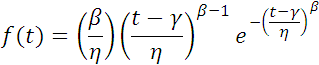
Poisson Distribution

This distribution is used quite frequently in reliability analysis. It can be considered an extension of the binomial distribution when n is infinite. It can be used to approximate the binomial distribution when n > 20 and p < 0.05.

If events are Poisson distributed, they occur at a constant average rate and the number of events occurring in any time interval are independent of the number of events occurring in any other time interval. For example, the number of failures in a given time would be given by:

Continue reading

Gamma Distribution

The gamma distribution is used in reliability analysis for cases where partial failures can exist, i.e., when a given number of partial failures must occur before an item fails (e.g., redundant systems) or the time to second failure when the time to failure is exponentially distributed. The failure density function is

for t>0

Continue reading

Exponential Distribution

This is probably the most important distribution in reliability work and is used almost exclusively for reliability prediction of electronic equipment. It describes the situation wherein the hazard rate is constant which can be shown to be generated by a Poisson process. This distribution is valuable if properly used. It has the advantages of:

  1. single, easily estimated parameter (λ)
  2. mathematically very tractable
  3. fairly wide applicability
  4. is additive  that is, the sum of a number of independent exponentially distributed variables is exponentially distributed.

Some particular applications of this model include:

  1. items whose failure rate does not change significantly with age.
  2. complex and repairable equipment without excessive amounts of redundancy.
  3. equipment for which the early failures or “infant mortalities” have been eliminated by “burning in” the equipment for some reasonable time period.

The failure density function is

for t > 0, where λ is the hazard (failure) rate, and the reliability function is

the mean life (θ) = 1/λ, and, for repairable equipment the MTBF = θ = 1/λ .

Continue reading

Normal Distribution

There are two principal applications of the normal (or Gaussian) distribution to reliability. One application deals with the analysis of items which exhibit failure due to wear, such as mechanical devices. Frequently the wearout failure distribution is sufficiently close to normal that the use of this distribution for predicting or assessing reliability is valid.

The other application deals with the analysis of manufactured items and their ability to meet specifications. No two parts made to the same specification are exactly alike. The variability of parts leads to a variability in systems composed of those parts. The design must take this part variability into account, otherwise the system may not meet the specification requirement due to the combined effect of part variability. Another aspect of this application is in quality control procedures.

The basis for the use of normal distribution in this application is the central limit theorem which states that the sum of a large number of identically distributed random variables, each with finite mean and variance, is normally distributed. Thus, the variations in value of electronic component parts, for example, due to manufacturing are considered normally distributed.

The failure density function for the normal distribution is
Equ. 1

where
μ = the population mean
σ = the population standard deviation, which is the square root of
the variance.

Continue reading

MTBF versus MTBCF

What is the difference between MTBF and MTBCF?

Usually, mean time between critical failure (MTBCF) is a term used when redundancy exists in a system. It is often used to differentiate system reliability from series mean time between failure (MTBF).  Series MTBF, or simply MTBF typically includes all failures without regard to any fault tolerance that may exist, whereas, the “C” in MTBCF indicates that only “critical” failures are counted, i.e., those that will cause the system to not meet specification requirements. That said, MTBF is sometimes used to really mean MTBCF.  This is often  organization and/or industry dependent – if unsure, ask!

Reliability Theory

Most modern engineering disciplines are based on applied mathematics. An engineer or scientist observes a particular event and formulates a hypothesis (or conceptual model) which describes a relationship between the observed facts and the event being studied. In the physical sciences, conceptual models are, for the most part, mathematical in nature. Mathematical models represent an efficient, shorthand method of describing an event and the more significant factors which may cause, or affect, the occurrence of the event. Such models are useful to engineers since they provide the theoretical foundation for the development of an engineering discipline and a set of engineering design principles which can be applied to cause or prevent the occurrence of an event.

Continue reading